The Heavy Mass School
Architecture for the Age of Hidden Intelligence
The only way to predict the future is to build it. A system that doesn’t just withstand the test of time, but gets better with it like a cast-iron skillet. The materials become part of the memories. History has a special meaning, especially the kind that endures. The future isn’t about shiny new shapes, but about using advanced technology to recover lost psychological comforts (silence, weight, ritual) and use them as psychological antidotes to AI-era anxiety. AI-era anxiety demands tactile permanence. The ‘heaviness’ is not in the structural load, but in the permanence of the interface and the honesty of the finish against the ephemeral digital world.
The Principles of Heavy Mass
- Intelligence is infrastructure, not interface.
- The hand must trust what it touches.
- Absence is design.
- Ritual over frictionless.
- Symbol over function.
- Local over cloud.
- Structure deserves to be seen.
- Materials age, intelligence learns… beautifully.
The Promise
A Heavy Mass home is heavy where it touches you and silent where it thinks.
The charred wood will silver at the edges over decades. The felt will soften with your hands. The dimensional panels will catch the same morning light in fifty years that they catch tomorrow. The brass will patina with the oils of your palm, recording the years in bronze and gold.
The intelligence will update invisibly, learning you better each season, anticipating needs you haven’t yet named. When the hardware finally upgrades, its successor will wake the same house—patterns preserved, rituals intact.
You will forget the house is smart. You will only know that you feel right when you’re inside it—calm, held, home.
That is the heavy. That is the mass.
Why now?
We were sold two lies.
Lie Number One: Minimalism.
We call it ‘clean lines.’ We call it ‘modern.’ But as an architect, let me tell you what it actually is: A confession of poverty.
We stripped away the wood, the stone, and the craft not because it was ‘better,’ but because drywall is cheap and skilled labor is expensive. We built blank boxes and called it ‘style’ to hide the fact that we couldn’t afford ‘soul.’
Lie Number Two: The Smart Home.
We filled those blank boxes with screens. We invited the entire chaos of the world into our bedrooms. We turned our sanctuaries into surveillance nodes.
The result? We are the most anxious, sleep-deprived generation in history. We live in houses that feel like hospitals and sleep with phones that act like slot machines.
The market is crashing. Not the housing market—the attention market.
People are tired. They don’t want another app. They don’t want a fridge that demands their attention.
They want Silence.
They want Weight.
They want to touch something that feels older than they are.
Our thesis is simple: The future isn’t about more screens. It’s about using the most advanced technology on earth... to make the technology disappear.
We aren’t building ‘Smart Homes.’ That era is over.
We are building Heavy Mass. Here, we are free to focus on the irreducibly embodied, the irreversibly committed, the genuinely novel want.
A house doesn’t become home by declaring it so—it becomes home through rituals that accumulate like sediment.
I. On Silence
The last thirty years were a mistake. We worshipped screens, turning them into sacred icons that demanded constant attention. The result was exhaustion, alienation, and loneliness.
Heavy Mass changes this. The intelligence is now hidden in the floorboards. Sensors are in the ceilings. The house acts, anticipates, and adjusts without asking for anything. The greatest compliment to a Heavy Mass home is that you forget it’s intelligent.
We don’t interact with the machine. We live in it.
II. On Weight
Minimalism was a confession of poverty, not a philosophy. Craft, material honesty, and time were unaffordable. When everything had to be cheap and replicable, we called it “clean lines.”
Today, CNC mills and robotic assembly make texture cheaper than blankness. A factory-finished dimensional panel costs less than a plasterer’s week of labor. Craft is no longer a luxury; blankness is. We need to bring back Weight.
Our nervous system trusts what it can touch. Heavy Mass gives us that trust. The grain of burned cedar, the softness of wool felt, wood veneer panels that breathe with the warmth of living grain, the shadow-play of simulated dimensional gypsum panels. These aren’t nostalgic choices; they are necessary ones. Mass is meaning. Weight is truth.
III. On Absence
The Japanese call it 間 (Ma)—the meaningful gap, the silence that makes the music.
A Heavy Mass home is selective, not minimal. Most surfaces remain exposed, like the sealed OSB, the color of raw honey. We use acoustic felt in deep earth tones, pre-finished wood veneer panels, and charred wood that remembers fire.
The negative space isn’t emptiness. It’s room to breathe, for your life to fill.
IV. On Fire Without Hearth
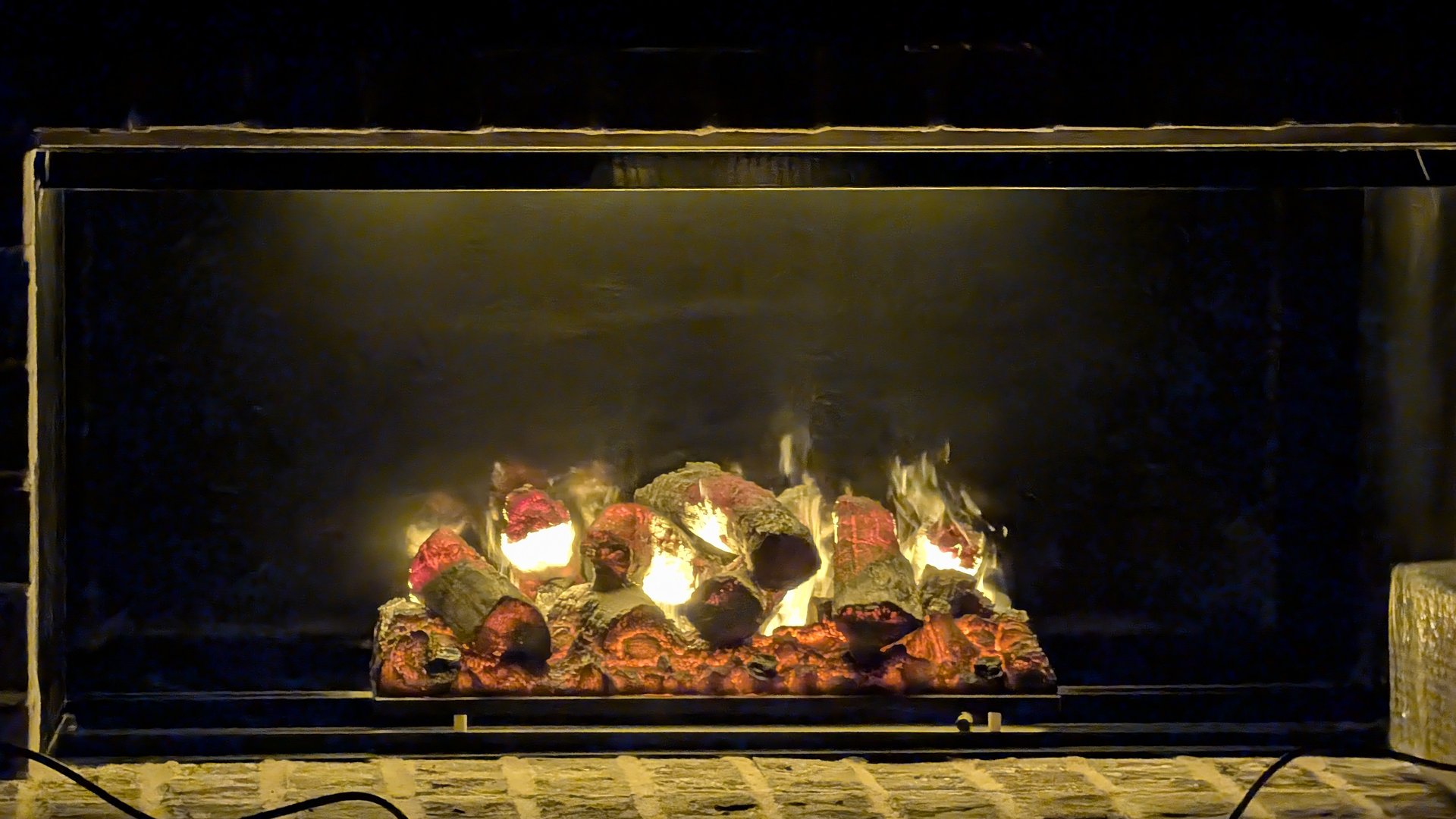
The ancient home was built around fire. We honor that instinct but untether it from mass. A Heavy Mass fire is water and light: LEDs, vapor, and psychological warmth.
The fire floats against a wall of dimensional panels, casting shadows. No chimney. No flue. No masonry. It’s just the comfort of flickering light.
The hearth was never about stone. It was about gathering. We kept the gathering, but dissolved the stone.
V. On Ritual
The touchscreen is the confessional of the surveillance age—frictionless, abstract, and forgettable. Heavy Mass replaces the tap with the turn.
A brass dial sits where your hand naturally falls. Rotate it through four detents, feeling each click in your wrist. The house shifts around you: light temperature, air exchange, presence sensitivity. Behind the dial is a mesh network, sensors, and inference engines. But your hand only knows brass, weight, and resistance.
We slow you down enough to mean what you ask. Asking for something should feel like something.
VI. On Time
A Heavy Mass home arrives in seven days. The site is prepared, permits filed, and panels stacked. Then: crane, crew, and keys.
This isn’t fast construction. It’s a preparation meeting opportunity. We spent months engineering so you could spend days moving in.
The home feels like it gets better with age. Charred wood weathers gracefully. Felt softens with touch. Dimensional panels cast the same shadows they will in fifty years. The intelligence gets better silently, learning you better each season.
The protocols are open. The hardware is standard. When the server fails in fifteen years, its successor will wake the same house. The logs die with the hardware. The patterns live in the replacement. We build for replacement, not dependence.
We built it in a week, but it will outlast the century.
VII. On Network
A Heavy Mass home shares nothing by default. The data stays inside the walls, patterns shared, only when you choose.
But the house can speak—to others like it, to you when you’re away, to services you choose. This is opt-in, not opt-out. The network is a gift, not a toll.
Thirty homes on a mountain, each silent, each listening. They know when the power grid strains, when the weather turns, or when a neighbor needs help. The network is mutual awareness, not surveillance. Heavy Mass homes holding space for each other.
The Elements
Structure: SIP Shell
Structural Insulated Panels form the bones—foam and engineered wood, factory-cut to aerospace tolerances, R-24 walls, airtight envelope. The structure is the insulation. No cavity, no thermal bridging, no wasted space.
Electrical chases are pre-routed at the factory. Cat6 to every room. Speaker wire to ceilings. LED runs to coves. When the panels arrive, the nervous system is already in place, waiting to wake.
Skin: Charred Cedar on Clip Rail
The exterior is shou sugi ban—cedar boards charred black, brushed to reveal grain, sealed against weather. They click onto aluminum rails that hold them proud of the wall, creating a 19mm rainscreen gap.
Light enters through the gaps at dawn and dusk. Shadow lines migrate across the surface through the day. The wall moves without moving. Rain drains invisibly behind. If a board is damaged, unclip it, click in a new one. Sixty seconds. The system forgives. The architecture endures.
Accent: Acoustic Felt Panels
Interior feature walls receive wool felt tiles in deep earth tones—charcoal, clay, moss, stone. The felt absorbs sound, softens the room acoustically, and invites touch.
The panels clip onto a mounting rail. No adhesive. No permanent attachment. Rearrange them. Replace a damaged tile. Change the color palette in an afternoon. The system adapts to how you live.
Felt brings warmth without weight. It is the soft counterpoint to charred wood and sculpted gypsum.
Accent: 3D Dimensional Panels
Where drama is needed—behind the floating fire, as a headboard wall, flanking an entry—we use dimensional gypsum panels. Patterns ripple like dunes, fold like origami, undulate like slow water.
The panels interlock with steel-reinforced joints, ensuring perfect alignment across any span. They arrive white, ready for paint or light-wash. When illuminated from the side, they become kinetic: shadows shift as the sun moves, as you move, as the room breathes around you.
These are not decorations. They are architecture in relief—the wall as landscape.
Interior Ground: Sealed OSB + Click-Lock Floor
Most interior walls remain exposed OSB, sealed with hardwax oil to a warm honey tone. This is not a budget choice. It is an honesty choice. The structural panel that keeps you safe deserves to be seen.
The floor is click-lock engineered hardwood or luxury vinyl plank—laid in hours, no adhesive, no nails. Damaged plank? Unclick, replace, done. The floor flows wall to wall without transition strips. The absence of interruption creates calm.
Fire: Water Vapor Flame
A linear insert floats against the dimensional panel wall. Ultrasonic transducers turn water into mist; LEDs illuminate the vapor into flame. The effect is startlingly real—flickering, rolling, rising—but cool to the touch.
No gas line. No flue. No clearances. The fire plugs into a standard outlet and a water connection (or a refillable tank for ultimate simplicity). Control it from your phone, or let the house decide: fire rises when you settle into the living room after dark, dims as you head to bed.
The fire is pure symbol—warmth without combustion, gathering without danger, the ancient element rendered in light and vapor.
Intelligence: Ambient and Invisible
The Heavy Mass nervous system:
- Presence sensing via mmWave radar in ceilings—knows which rooms are occupied, by how many, in motion or still
- Climate sensing via distributed temperature, humidity, CO2 monitors—adjusts HVAC and ventilation without thermostat negotiation
- Circadian lighting that shifts color temperature from cool morning to warm evening—no switches, no thought
- Security via PoE cameras with on-device AI—faces recognized locally, never uploaded, alerts only when needed
- Audio via invisible ceiling speakers—sound fills the room from nowhere
All of it runs on a local server in a closet. No cloud dependency. No subscription. No company watching. The intelligence belongs to the house, and the house belongs to you.
Interface: Brass and Weight
Primary controls are multi-button keypads in brass surrounds—one tap for lights, double-tap for scenes, hold for dimming. The brass patinas with use, recording the touch of years.
One rotary dial per home serves as the mode selector:
- ☉ Sun — Day mode. Cool light, active ventilation, the house energizes.
- ☽ Moon — Evening mode. Warm light, sound dampening, cortisol management begins.
- ⌂ Shelter — Away mode. Perimeter secured, systems in standby, energy minimized.
- ◯ Null — Presence without agenda. The house stops anticipating. It simply coexists.
The dial clicks through detents with satisfying resistance. Behind it: two hundred nodes responding. But the hand knows only brass.
The Experience
Approach
You arrive through managed landscape—native grasses, a gravel path, young hardwoods that will outlive you. The house emerges: a low A-frame wrapped in charred cedar, black boards separated by shadow gaps, light leaking through at the edges.
There is no visible lock. As you approach, the house recognizes your gait—a biomechanical signature captured by presence sensors. The door latch releases with a soft thunk. You push it open yourself. The house permits; it does not perform.
Entry
Inside: warmth. Not temperature—feeling. The walls are honey-toned OSB, sealed to a soft sheen. A feature wall of acoustic felt in charcoal and clay tones absorbs the sound of your arrival. The floor is pale oak, clicking softly underfoot.
Light comes from nowhere visible—thin gaps where wall meets ceiling, coves that glow without source. The color is warm, the intensity calibrated to the hour and the winter grey outside.
Living
The main room opens to the A-frame peak. One wall is dimensional gypsum—interlocking panels in a pattern like frozen wind, shadows shifting as clouds move past skylights above.
Against this wall: fire. A linear vapor flame, three feet wide, rising from a minimal black plinth. The flames dance, roll, merge, separate. They look utterly real. They are water and light.
Below the fire, the brass dial. Rotate it and feel the room shift—light warms, speakers hush, the house settles into evening mode around you.
Rest
The bedroom is quieter still. Walls of sealed OSB, one accent wall of deep moss felt. The bed platform floats on a recessed base, lit from beneath with a warm glow that fades as you lie down.
There are no switches. Light rises with you in the morning—slowly, reddening to amber to white over twenty minutes, synchronized to your alarm or your natural wake time. At night, one brass pull beside the bed: tug once for silence mode (all sensors pause, the house stops listening), tug twice for emergency (full lights, alerts sent).
The room breathes. You sleep.
The Numbers
Timeline
| Day | Activity |
|---|---|
| 0 | Site prepared: foundation, utilities stubbed, permits in hand |
| 1 | SIP panels delivered, walls craned into place |
| 2 | Roof set, weathertight, rough MEP connected |
| 3 | Exterior WRB + clip rail, flooring installed |
| 4 | Charred siding, interior felt + dimensional panels |
| 5 | Kitchen, bath fixtures, water vapor fire |
| 6 | Smart home activation, punch list |
| 7 | Walkthrough, keys |
Cost (1,200 sqft)
| System | Total |
|---|---|
| SIP shell, certified modular | $33,600 |
| Foundation + site prep | $14,400 |
| Windows, doors (triple-pane) | $18,000 |
| Charred cedar + clips + WRB | $16,800 |
| Interior: sealed OSB finish | $2,400 |
| Acoustic felt panels (200 sqft) | $4,000 |
| 3D dimensional panels (150 sqft) | $4,500 |
| Click-lock flooring | $6,000 |
| Water vapor fireplace | $3,000 |
| Kitchen + bath | $18,000 |
| Smart home stack | $8,000 |
| Brass controls (10 locations) | $1,500 |
| Electrical + plumbing | $18,000 |
| HVAC (mini-split) | $8,000 |
| Field labor | $10,000 |
| Contingency (10%) | $16,600 |
| Total | $182,800 |
$152/sqft all-in. Seven days. Existing supply chains. No R&D.
This isn’t cheap. It’s honest. Every dollar goes into what you touch, what lasts, what thinks.
PS: After a water leak destroyed my home, I spent nine months rebuilding from first principles. This isn’t theory. It’s tested. Every detail described here exists—the dimensional panels, the brass dial, the silence mode. I built Heavy Mass to prove it works. Now I’m building it for others.